Aesop's Wolf-Dog?
'Aesop’s Wolf-Dog?'
2026 Tina Summers
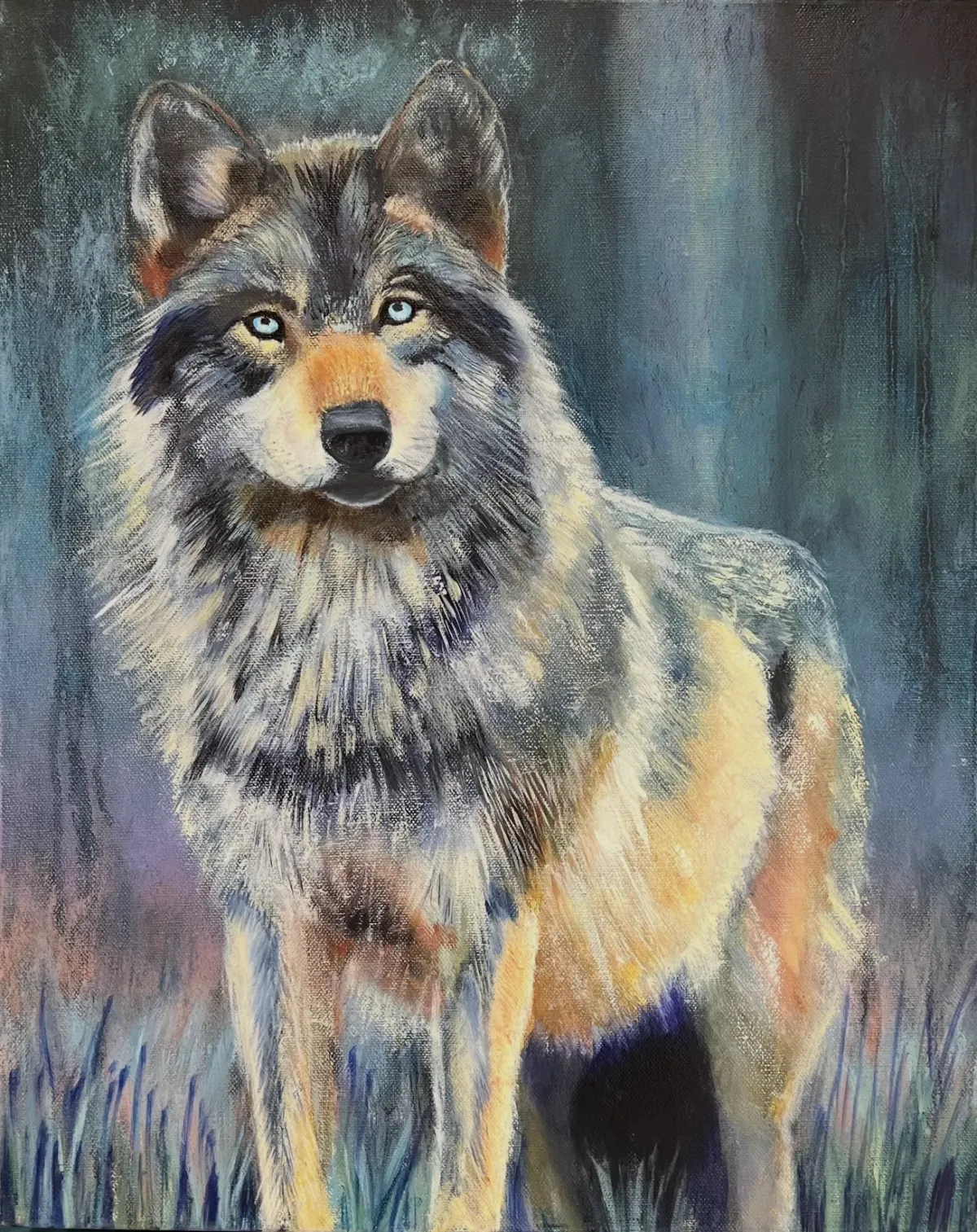
oil on canvas
16 x 20"
My Friend,
Aesop is almost as much of a mythical entity as characters in fables accredited to him. I’m not going to argue whether he was a historical figure, but it’s easier for me to write about him as if he was real. All we need to know is Aesop was a storyteller and he wrote fables, short, fictional stories that contain a moral lesson. One such story is ‘The Dog and the Wolf’.
The Dog and the Wolf
Text from Lit2Go
A gaunt Wolf was almost dead with hunger when he happened to meet a House-dog who was passing by. “Ah, Cousin,” said the Dog. “I knew how it would be; your irregular life will soon be the ruin of you. Why do you not work steadily as I do, and get your food regularly given to you?”
“I would have no objection,” said the Wolf, “if I could only get a place.”
“I will easily arrange that for you,” said the Dog; “come with me to my master and you shall share my work.” So the Wolf and the Dog went towards the town together. On the way there the Wolf noticed that the hair on a certain part of the Dog’s neck was very much worn away, so he asked him how that had come about.
“Oh, it is nothing,” said the Dog. “That is only the place where the collar is put on at night to keep me chained up; it chafes a bit, but one soon gets used to it.” “Is that all?” said the Wolf. “Then good-bye to you, Master Dog.”
Better starve free than be a fat slave.
The moral of the story is freedom is worth more than abundance.
But what if the Wolf and the Dog were one and the same?
Who says the wild Wolf or House-Dog must choose starvation as the cost of freedom?
Can’t abundance also walk hand in hand with freedom?
This painting explores the moral lesson in Aesop’s fable; it depicts an inquisitive, almost approachable wolf with a round belly that speaks of abundance. It argues, does freedom require one to starve or to live in a poverty-mindset? People in survival-mode don’t have the capacity to be curious since all their energy and mental load is exhausted by getting through each day. But freedom doesn’t have to be a fight for survival. A wolf that is curious is a wolf that feels safe and secure in itself and in it’s environment; and it is abundance that makes room for it.
In ‘Aesop’s Wolf-Dog’, we are offered an alternative. One of freedom, abundance, curiosity, and making one’s own path forward.
The Creative Process
Throughout the writing of the creative process, I’ll refer to the subject as a wolf for ease, as a Wolf represents the concept of freedom more than a dog.
This time I couldn’t help myself. I had to tweak the source for the Fat Over Lean assignment given. I adjusted the composition so that the Wolf dominated the surface area and gave it an inquisitive expression by tilting the head.
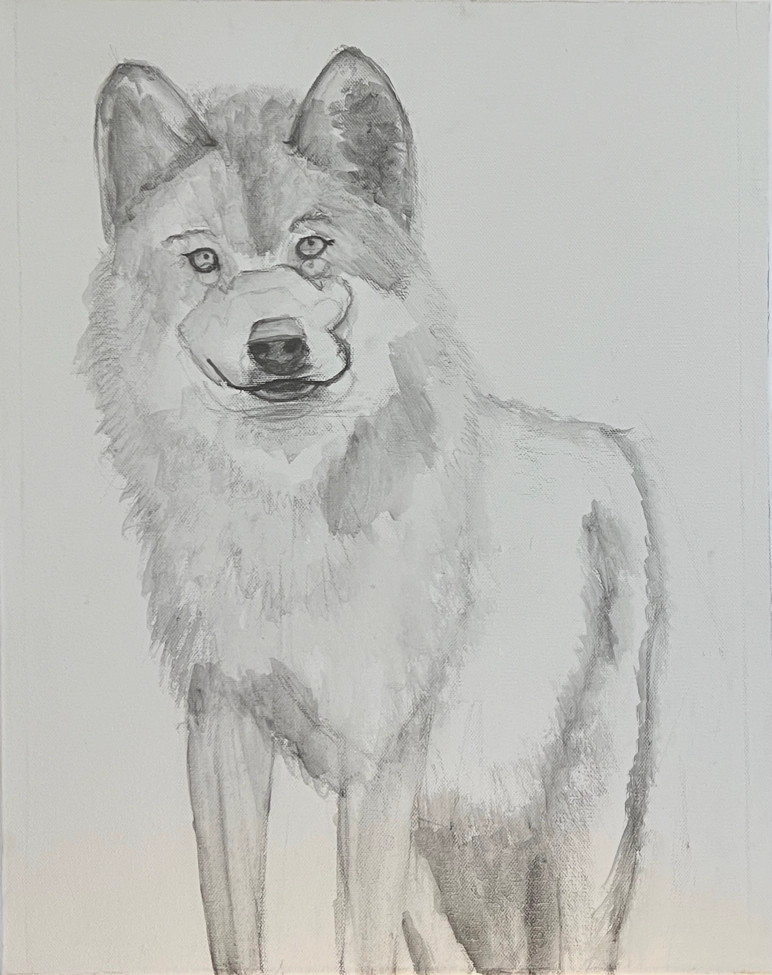
The painting began as a sketch using water soluble graphite. The water-soluble graphite was a personal choice and not a requirement. I made a few errors in the proportions on the face, so it has almost a double-image look to it in this underneath layer (oops). When it was dry, I sealed it with a fixative spray so that the graphite wouldn’t interfere with the subsequent oil layers.
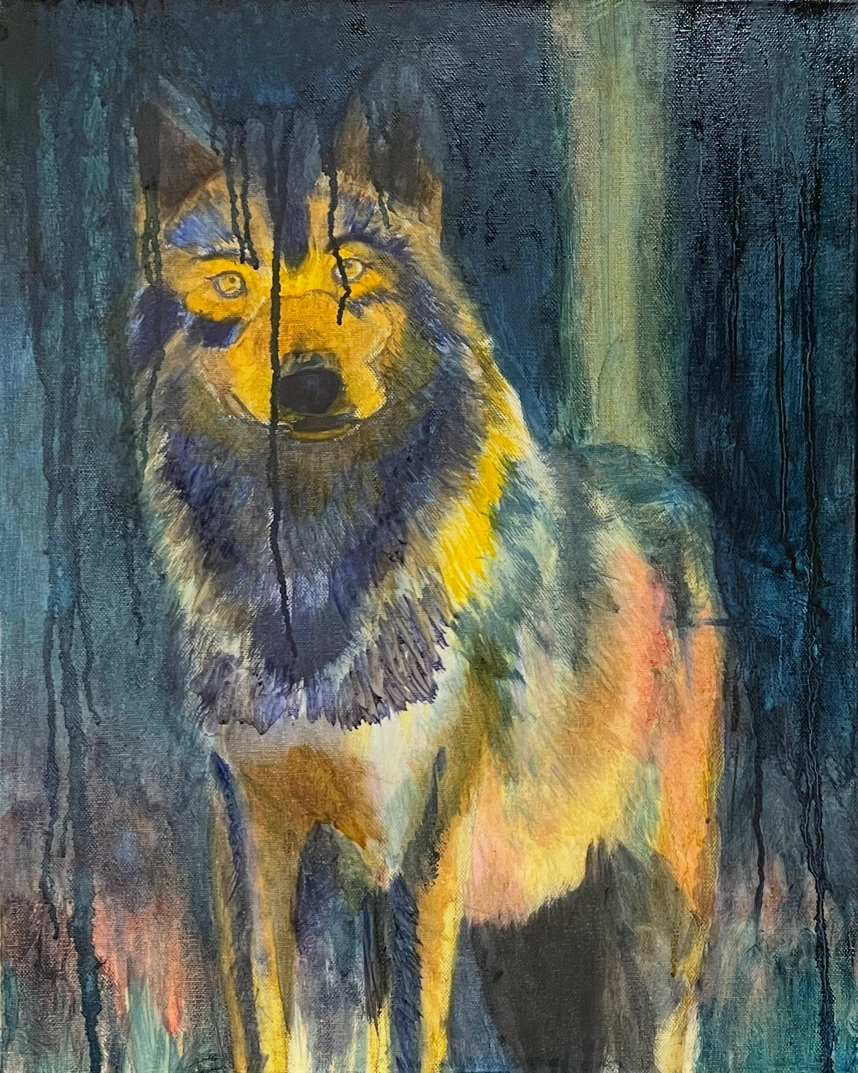
The transparent layer was a lot of fun. I love the effect of drips! I tried to think about where I wanted the glow from this transparent layer to shine through in subsequent layers, settling on parts of the body and the eyes. I love how layering can achieve a glow from within the subject.
I started the opaque layer in the background, but when I stepped back from the painting, I noticed that the darkest values were missing, so I went back in with the transparent darks especially on the face and fur at the front of the wolf. Going back in with the opaques on the background, I tried to keep as much of the drips in the background while still keeping it loose and soft. I wanted the bare suggestion of woods, so I again used my favourite scumbling technique to keep it soft and loose. Happy with the result, I moved onto the opaque layer on the wolf.
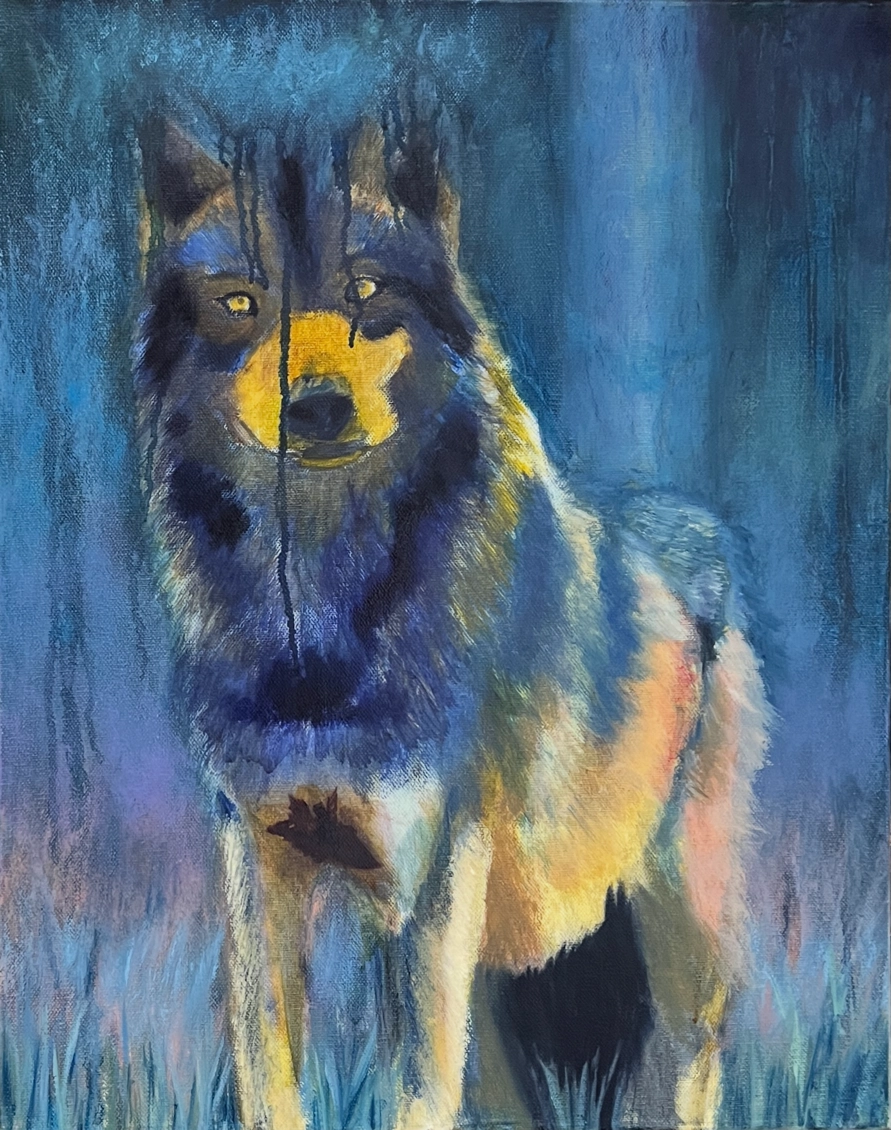
This is where the painting grew difficult and stayed in the ugly, messy middle for the longest time. Keeping in mind the warm and cool rule with oil paints was hard. It had been months since I’d last used oil paints and worked with warm and cool. I was out of practise. It took some time to work out where to place the warm and cool paints, especially in relation to what was placed next to it. It quickly became obvious where I’d made mistakes, so I’m encouraged that my eye has been trained to see what (temperature) needs to go where even if I don’t yet understand it at first. I took the coaches’ feedback into consideration, especially when attempting to keep my proportions accurate.
At some point I realised that my painting wasn’t exactly matching the colours I was seeing in the source but once I lay the colours down, I preferred what I had intuitively mixed. I think it brings a vibrancy and a life to the wolf. One of the reasons I chose the study under the Milan family was because of their bold use of gorgeous colour. It seems I’ve also adapted to the bold, exaggerated use.
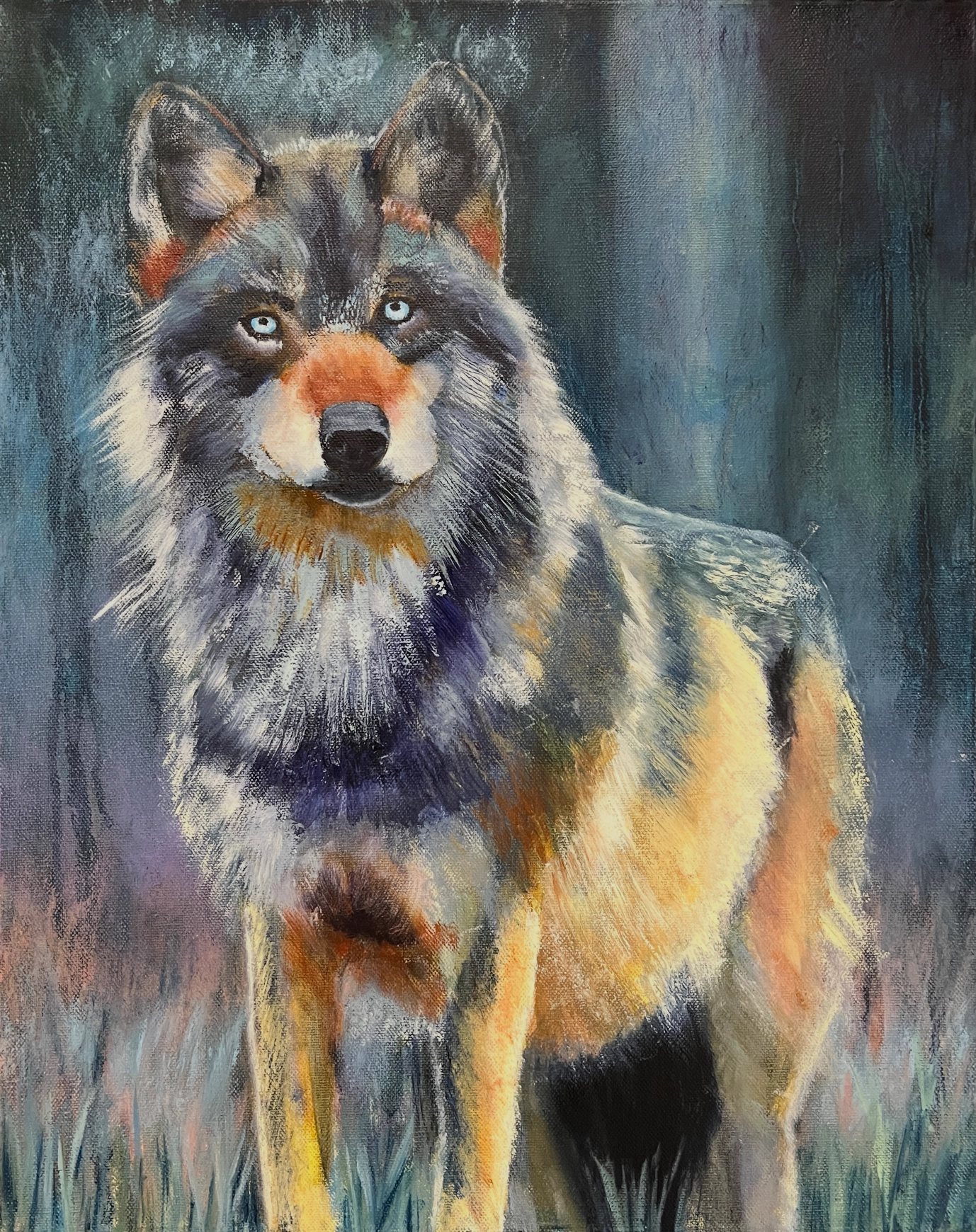
I needed some time away from the painting to really think about and focus in on the final details. I asked for feedback from the coaches, who gave some helpful tips to resolve the painting – what they would do next if the painting was theirs. It was an ideal approach from the coaches’ perspective because it gave me the freedom to do what I wanted while also providing a suggested direction. I needed a few days to (quite a few!) to process what to do and where to go. Once I made the decisions, I spent one final day in the studio with the finishing touches.
As always with a challenging painting, it’s not until the final hours when the painting is beginning to resolve that I start to look at it with a sense of accomplishment. Like a hundred loose threads woven together in the final stages to produce a completed work.
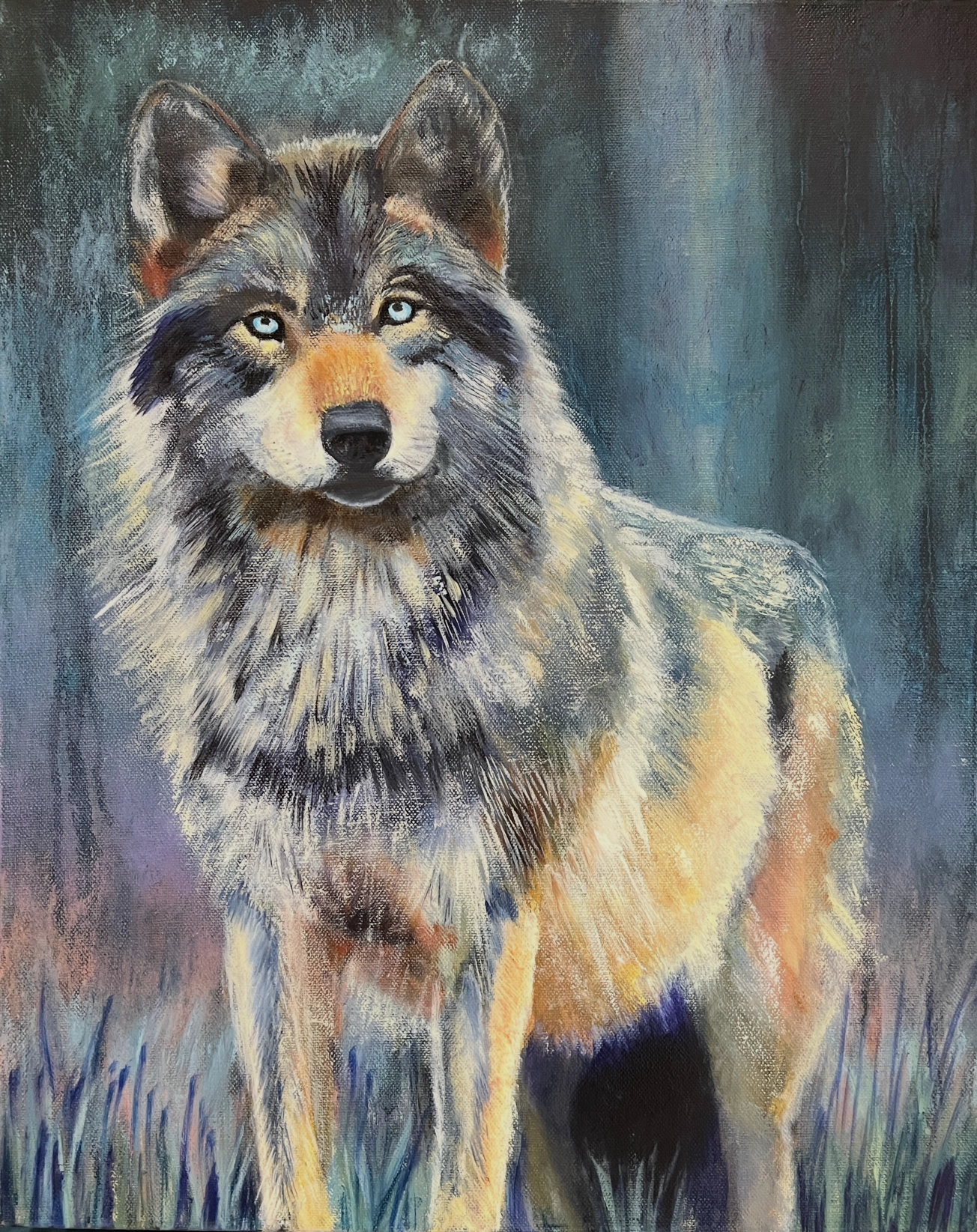
‘Aesop’s Wolf-Dog?’ is my own journey of what freedom and abundance can look like, and I hope it invokes a curious contemplation for others.
xx
Tina