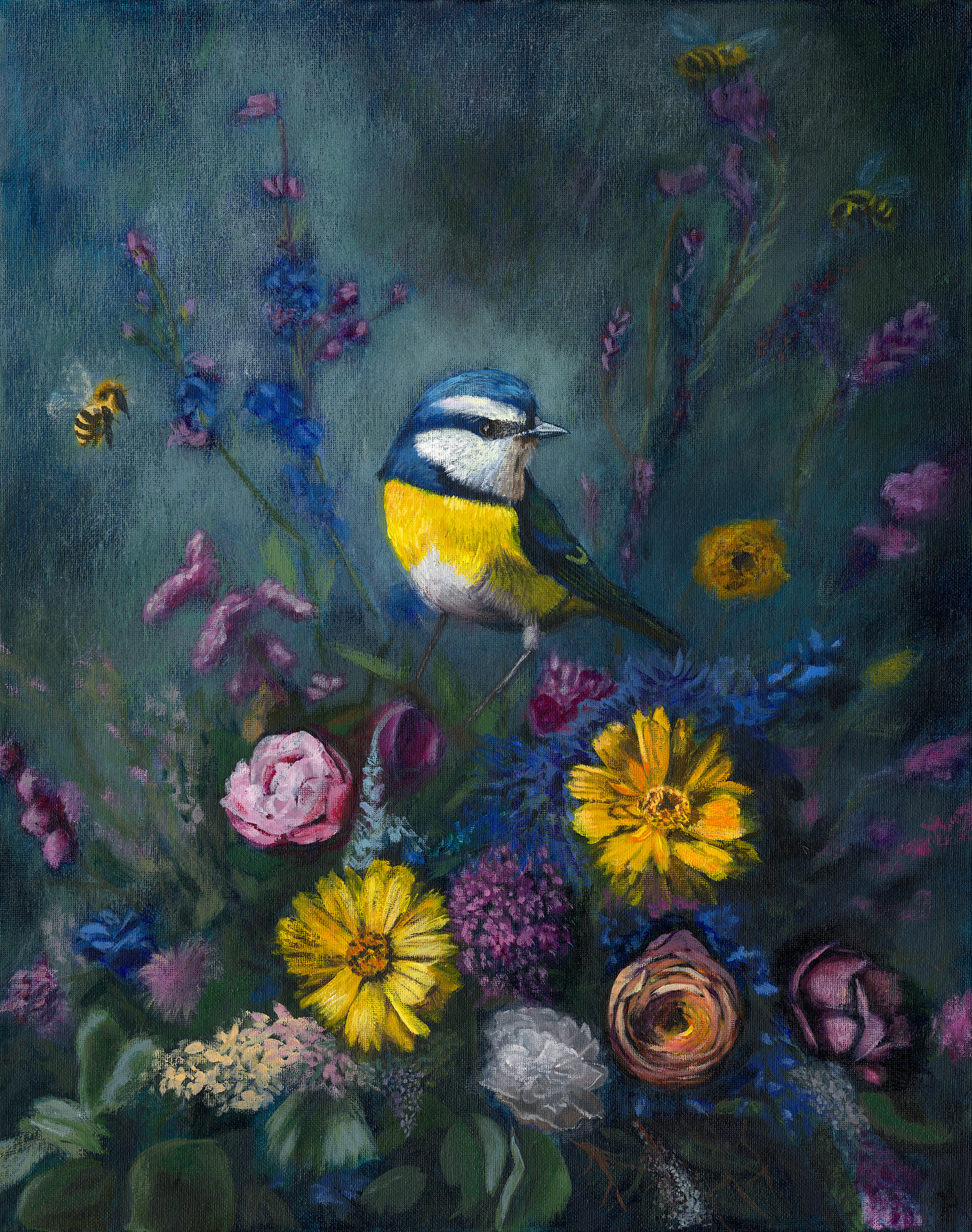
Eurasian Blue Tit on Floral Bouquet
Eurasian Blue Tit on a Floral Bouquet
My Friend,
As soon as I saw this assignment, I knew it was a painting my mum would love. I asked her if she wanted a painting for the upcoming Mother’s Day and she quickly responded with yes. I offered her a choice of three that I was happy to paint from the sources we were provided in the Milan Art Institute Mastery Program. I wasn’t surprised with her choice. A little Eurasian Blue Tit perched on a floral bouquet with some lovely little bees in the background.
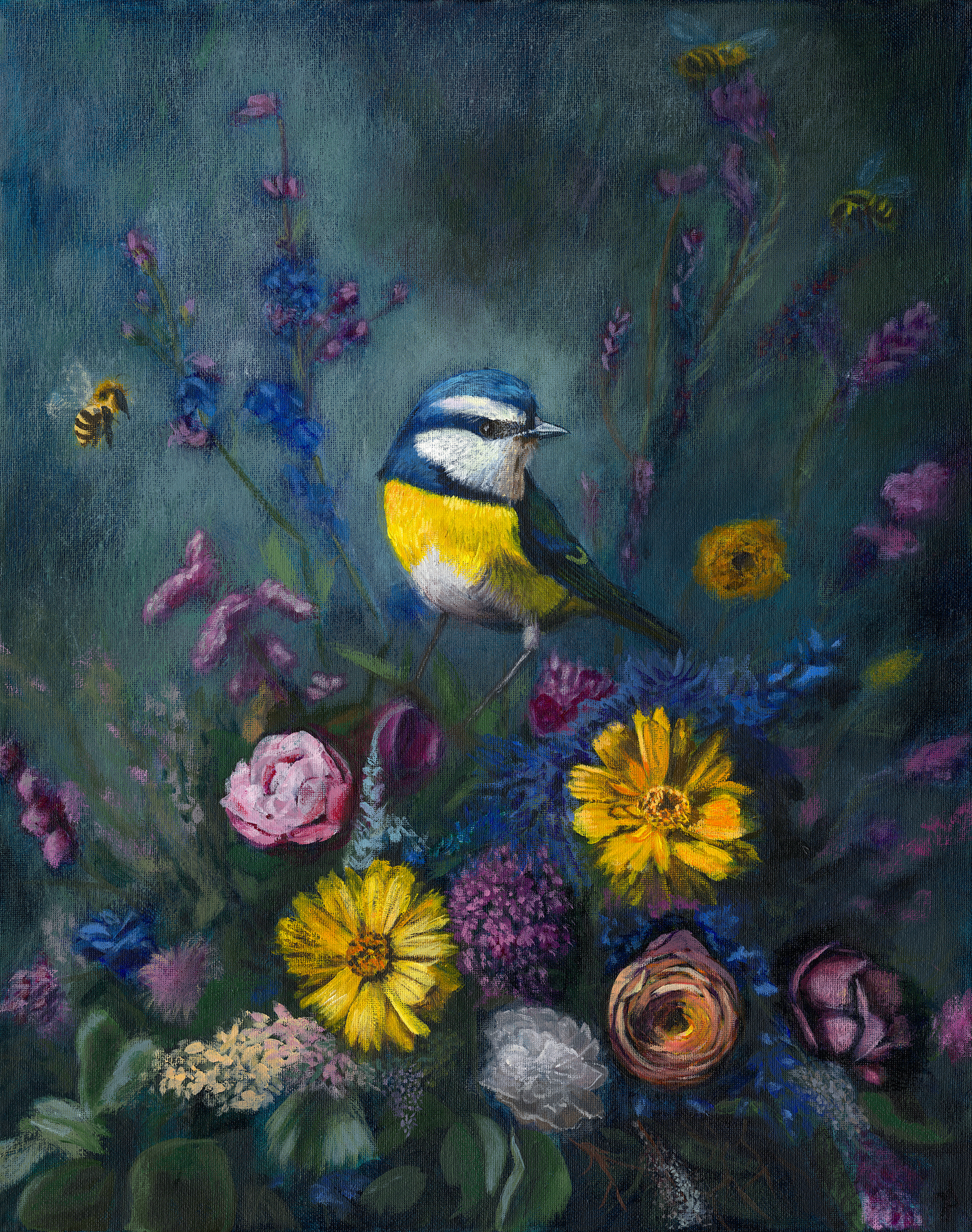
Acrylic on canvas
16 x 20"
Studio Playlist – Still obsessed with BTS’ Arirang album. The entire album is on repeat while painting. No skips!
For this acrylic assignment, I wanted to learn to master soft edges and where to apply them. Using soft and hard edges is an important technique for painters since paintings require both. The hard edges draw the eye as a focal point while softer edges are used to recede or help the eye pass over it the area easily. I decided that I wanted the background to remain soft and abstracted with the bird and a few select flowers as the focal points drawing the viewer’s attention around the painting easily. I also needed to learn how to transition from hard to soft or from subject to background more effectively.
I began with a blue base that I then subtracted out the lighter mid-tones and highlights and the basics of form in the approximate proportions. Although I’d done this earlier in the legacy version of Milan’s Part 1 in oils, this was only my second time using this technique with acrylics.
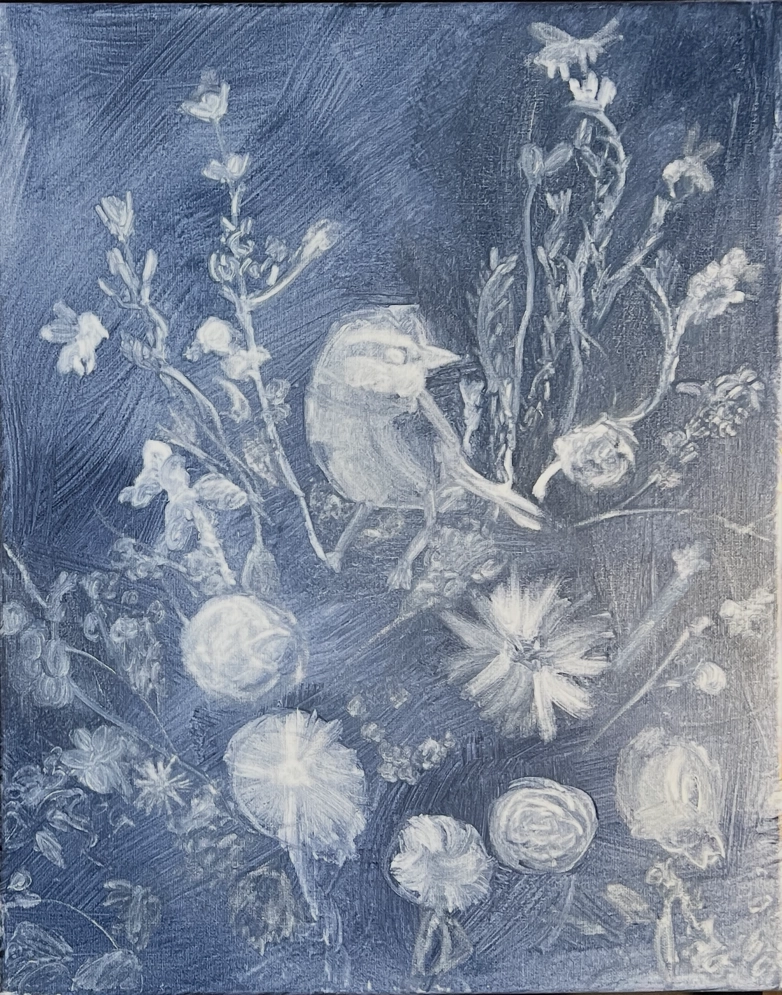
On my previous attempt beginning with a subtraction in acrylics for the still life assignment, I’d forgotten to dampen the canvas, and I hadn’t coated the canvas with an extra layer of gesso. This time I spent the extra time on the preparation, and it paid off. The subtraction was much easier the second time around. Keeping the painting ‘loose’ in this stage is helpful to my overall tendency to paint ‘tight’ all over. Subtracting the ‘hint’ of a flower in the background was surprisingly fun and allowed me to flow freely. My favourite painting motto has always been ‘I can fix it in the next layer’!
It didn’t take long for the subtraction layer to dry, so I was able to begin the next layer after lunch. The second layer uses transparent paint to ‘colour’ in the subtractive layer, keeping the focus on the darker and mid-tone values and rough form shapes. I still managed to keep the background flowers quite loose. I was quite chuffed with that. I kept almost chanting to myself every time I was about to try and go too defined, to keep the edges soft and the hint of a flower. By this time, I’m beginning to wonder if the painting technique I need to develop is actually restraint. Knowing how and when to stay loose and when to tighten for effect. The transparent layer is definitely the time to stay loose and the next day I’d begin to tighten some areas with the opaque layer.
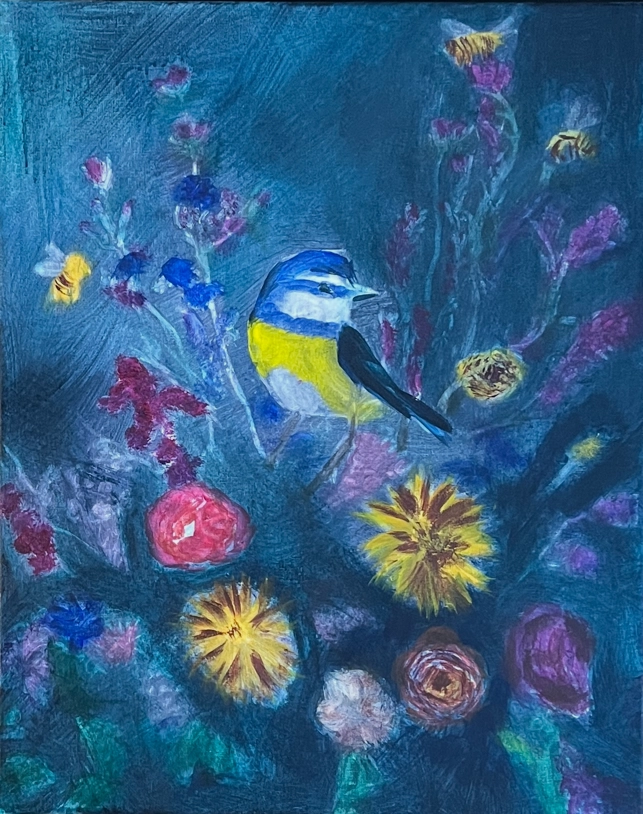
Before I started that the next day, I assessed the values in the transparent layer and saw that my darkest areas were not as dark as they needed to be. I lay out some more dark transparent paint and focused on this for the first part of the session. I used a glazing medium to help speed up drying process. I was ready for the opaques after lunch.
I began the opaque layer with the background. Scumbling is one of my favourite techniques and one I did intuitively before the Mastery Program. Now I just know how to use it to a greater effect. My intention was to continue to stay loose in the background to draw the viewer’s attention to the bird and selected flowers. I really love painting loosely. There’s a lot of freedom and quiet confidence in it.
The flowers were extremely challenging. I’m not going to lie. This wasn’t something that came easily or naturally to me and no matter how much I worked on them, they still were not quite ‘right’. I paid close attention to the lesson using complements to create the natural hues I was trying to replicate for both the petals and the leaves. I still need to learn to master the transition between more abstracted form and realism.
These assignments are great because they force me to think about value, hue, brushstrokes, and edges. This lesson had me practising all of these at the same time in the opaque layer. It was a lot to hold in my mind mentally. Yet not too much because of the assignments that preceded it.
It’s taking far longer that the assignment is supposed to. I refuse to move forward or rush a painting when I know I haven’t yet mastered the techniques. It takes me longer because I have to think about each technique while I’m planning and laying each brushstroke. I get tired of working on one aspect for too long, so to break it up I moved onto different parts of the painting going from the background, the bird and the floral bouquet as I need to.
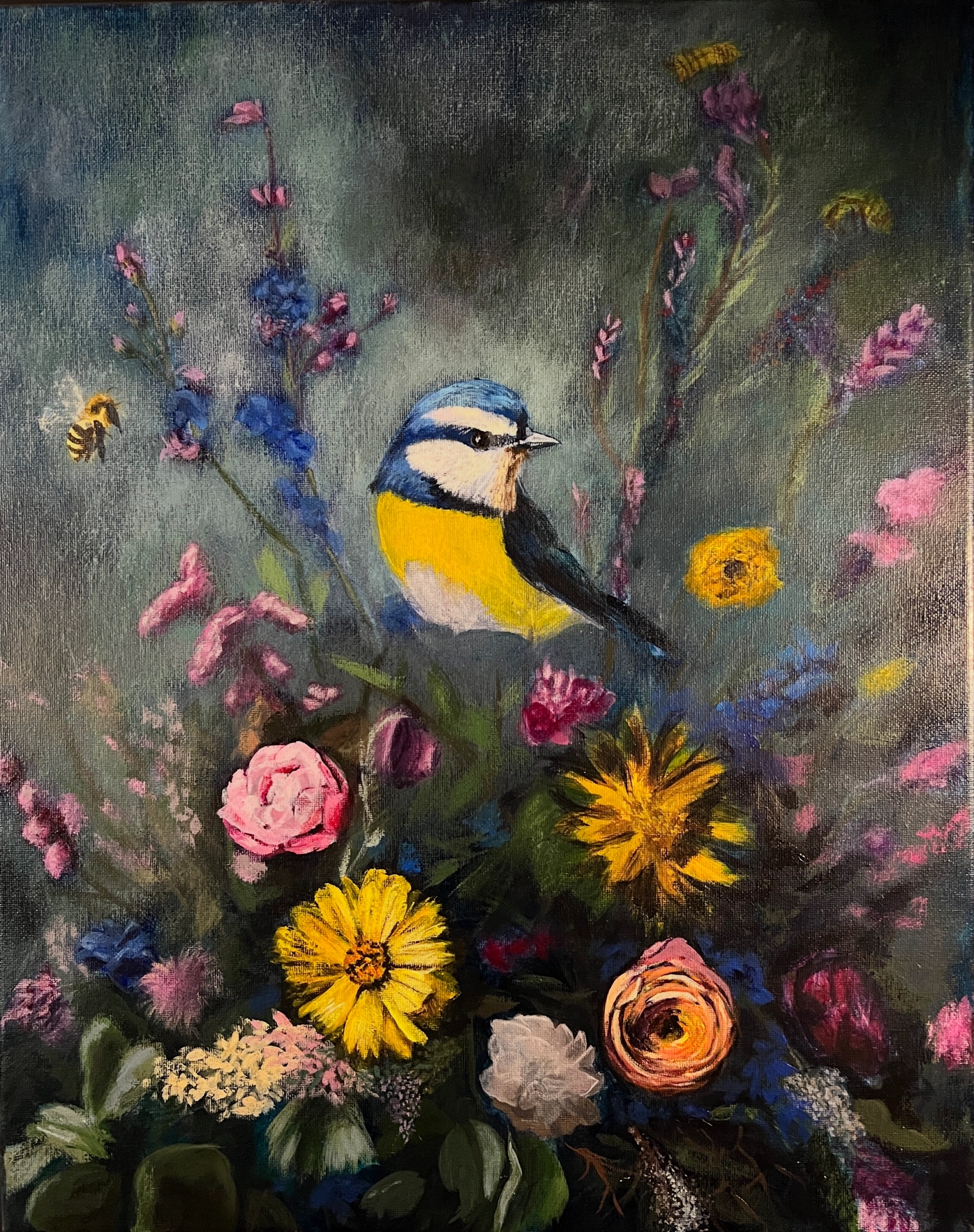
The bird was a delight to paint as a subject. I chose a vertical line from the face down it’s body and kept that as tight and as realistic as I wanted to go. As the distance increased away from this line I softened and kept the details loose and restrained. The effect created a lovely 3D form that looked as if the bird could fly away at any moment. This was a huge epiphany for me. I don’t have to be tight and highly detailed everywhere to achieve the same effect, and I found it far more beautiful.
The bees were also fun to paint. I varied how soft and hard the edges were for the bees as well. I didn’t want the foreground bee to have as much detail as the bird, but not as loose as the background bees. It was a delightful challenge. The wings I tried to look like they were in motion, but I’m not sure how well I achieved that in this piece.
I was thrilled with how well this painting turned out and was very happy to give it to my mum for Mother’s Day. In the following days after completing the painting I showed a few different people. The response was the same, ‘Are you doing prints of this?’ Initially I hadn’t planned on it since I wanted it to be special for mum, but by the third time I heard the question I told God I could take a hint. I asked my mum’s permission since it was a gift for her and she was happy for me to have a limited edition giclée print of her painting.